

EMTECH Space Leads ESA’s new project ALF-E
Athens, October 1st, 2026
EMTECH Space S.A. has been awarded a European Space Agency (ESA) contract as prime contractor to lead the Advanced Low-Frequency Electric Field Pre-Verification Method (ALF-E) project. The consortium includes Thales Alenia Space Italia (TAS-I) and the Institute of Communication and Computer Systems of the National Technical University of Athens (ICCS-NTUA) as subcontractors.
Over a 24-month execution timeline, EMTECH Space and its partners will mature a novel pre-verification framework from Technology Readiness Level 3 (TRL 3) to TRL 5, towards new standards for low-frequency electromagnetic compatibility (EMC) in space systems.
ALF-E: Bridging the Low-Frequency Verification Gap
Testing low-frequency electric fields presents a major challenge for the space industry. Standard electromagnetic compatibility standards lack fully standardized test methods for sub-MHz frequencies. In physical test facilities, standard anechoic chamber absorbers become ineffective at low frequencies, while chamber walls and metallic equipment introduce severe reflections that obscure true spacecraft emission levels.
ALF-E develops a validated pre-verification methodology for predicting low-frequency electric fields at the spacecraft level across the 0.1 Hz to 10 MHz range. By combining advanced modelling, testing, and validation, the methodology will reliably correlate unit-level emissions to spacecraft-level electric-field behavior at these low frequencies, particularly regarding near-field interactions and under-moded cavities.
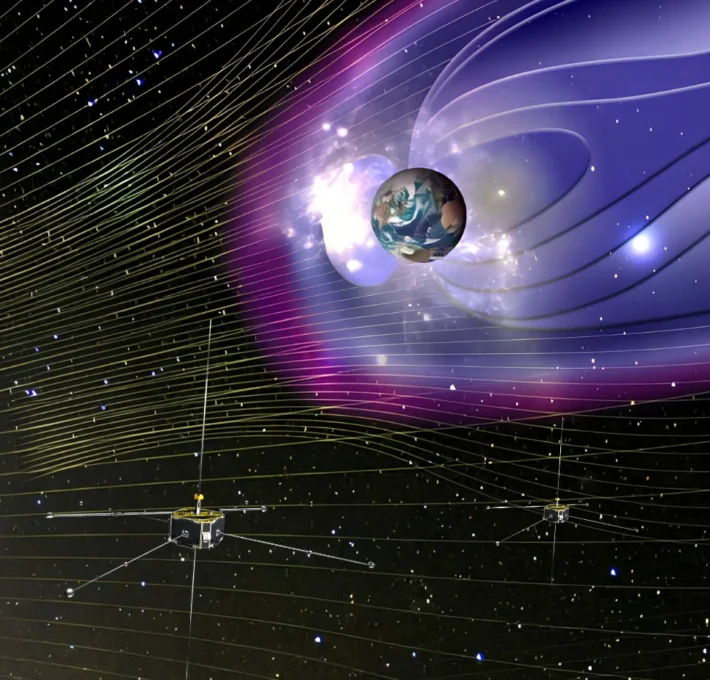
The framework will provide an efficient, model-based compliance approach for scientific missions with stringent EMC requirements such as ESA's multi-spacecraft Plasma Observatory (PMO), to be adopted within early phases of design.
Phased Methodology and Testing Campaign
By addressing lessons learned from prior activities, the consortium is enhancing predictive accuracy for sensitive scientific payloads and delivering a rigorous, validated methodology that addresses system-level electromagnetic interactions early in the design cycle.
The work is built in structured stages:
- Simplified Configurations: Initial modeling of simple cable and harness configurations in free space.
- Complex Coupling: Progression to shielded, grounded, multi-harness, and cavity-coupled environments.
- Spacecraft Integration: Culmination in a combined model of a reference spacecraft.
Model development runs in parallel with a dedicated physical test campaign that provides both source-characterization data and independent field-validation data. This approach directly addresses lessons identified by the consortium from earlier ESA-funded work, where harness models lacked measurement fitting and system-level interactions were not experimentally validated.
Consortium Roles
- EMTECH Space (Prime Contractor): Responsible for overall project management, quality assurance, and core modeling activities, including model development and validation for simplified configurations, preparation of test procedures, and ultimate modeling of complex, spacecraft-representative configurations.
- ICCS-NTUA: Leads the identification of modeling techniques, research of test methods, and validation of complex-configuration models.
- Thales Alenia Space Italia (TAS-I): Leads the preparation and execution of the physical test campaign at its specialized EMC facilities.
